Do you remember the first song lyric to really hit you - make you stand up and take notice - strike you as something fundamentally different to the pop music you listened to on the radio while being being a moody teenager longing for some spark of romance and escapism in your life? No? Ok then sorry I asked.
But if you did or are just curious about the experience, read on. It is the reason I give lyrics such a high weight when it comes to rating songs (which of course I do).
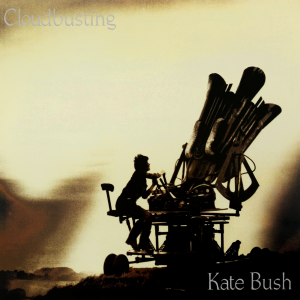
Cover art for the single “Cloudbusting” by Kate Bush. Kate Bush Music Ltd./EMI Music Publishing Ltd
"I still dream of Orgonon" I first heard this opening line when I was 14 year old, and I think it reshaped my understanding of the way pop song lyrics can be used. I had hear the song a few times before - it got regular airplay even 8 years after its release - but the words had washed over me as the gorgeous, driving strings-led march of the melody drew my attention. Anyway, At first I thought I was missing something - was I meant to know what this ``Organon'' thing was meant to be? It did bare a passing resemblance to the word orgasm which perked my ears up, but it appeared as a proper noun, a thing or a place. Since I have learned that (i) no, the author did not assume we knew it, and (2) yes, it is related to orgasm, but (iii) it is a place and, (iv) in the music video Donald Sutherland lives there.
I was vaguely aware of the stature of Kate Bush in the culture of British pop music, how she had achieved a rare combination of being weird and experimental in her lyrics and music while also becoming an absolutely massive pop star in the late seventies and throughout the eighties. This would be the first full excursion into her world. One can listen to and appreciate lyrics in many ways, but to me Kate Bush's story-telling, filmic lyrics demanded an analysis as I "watch" the lyrics unfold. Of course, it is influenced by what I now know about the story, but that's ok.
So lets analyze the heck out of them.
--
"I still dream of Orgonon I
wake up crying.
You're making rain and you're just in reach
when you and sleep escape me"
--
The viewpoint character (let's call him Peter) is dreaming of someone special to them. Someone who, mysteriously, is making rain - figuratively? literally? - and just when they are about to connect in the dream the waking world intervenes. Something in the poetic phrasing and delivery - "when you and sleep escape me" make it clear how heart wrenching it is. These two people have been torn apart.
--
"You're like my yo-yo that glowed in the dark
What made it special, made it dangerous
So I bury it and forget"
--
A child's toy, recalled by an adult? Emotionally tied to that special person Peter was dreaming of. Danger - exciting, not scary. Peter returns the yo-yo to the actual or figurative ground, burying their emotions and memories. They contain pain too.
On to the chorus:
--
"But every time it rains, you're here in my head
like the Sun coming out
Ooh, I just know that something good is gonna happen
I don't know when
But just saying it could even make it happen"
--
The memories return whenever it rains. Hmmm, the subject of Peter's dream makes rain. This seems key. And this time, instead of sadness there is optimism. The rain and the memory are signs of something good coming around the corner. There is a complex mix of emotions associated with the subject. Sadness, yearning, danger, joy. And belief (delusion?) in being able to manifest something good from the memories - "Just saying it could even make it happen", an incantation to bring Peter some peace of mind.
SECOND VERSE
--
"On top of the world, looking over the edge,
you could see them coming.
You looked too small in their big black car
to be a threat to the men in the power"
--
As John Hodgman was so fond of saying "Specificity is the soul of narrative" and the same is true in pop lyrics. Bush is the master of it. Bush lays out the emotional specificity in the first verse and comes in with the situational specificity in the second verse.
Our main character, (from up on a hill or tower?) remembers seeing the subject of his memories taken, one can infer, agents of the government. A big snippet of information. This seems likely to be the event that led to their separation. But she shows restraint in telling us too much. She returns to emotions of witnessing this. "You look too small in their big black cars". There is shock that their subject can possibly be of interest to the shadowy authorities. There is a clash of worlds: the magical, childlike one that Peter inhabited, and the wider, harsher world. Why this is happening is unknowable to Peter in this memory.
On we go.
--
"I hid my yo-yo in the garden
I can't hide you from the government
Oh, God, Daddy, I won't forget"
--
Things finally come into focus - at least in part. By this point we probably could have guessed, but Peter is recalling his childhood, and the subject is his Dad. His Dad who was taken from him as a child by the government.
Pieces come together in the emotional crux and climax of the song. The yo-yo - the physical thing, the memories, those he was able to bury and hide away, cannot stay that way. They shouldn't.
As a child he is unable to protect his parent. As we all are. As young kids, if we are very fortunate, we believe our parents are indestructible and can work magic. They will always be there to protect us. Then comes the time when the realization hits that your parents are fallible and mortal. When I was around 12,13 I became obsessed with my parents mortality. Every time my parents were out of the house I envisaged all the ways harm could come to them, and would worry until they returned. The genius of the lyrics is to take a specific situation and extract the universal, human meaning from it.
But in this moment, he determines not to forget, to not bury the yo-yo. And we are led to the chorus again.
--
"But every time it rains, you're here in my head
like the Sun coming out
Ooh, I just know that something good is gonna happen
I don't know when
But just saying it could even make it happen"
--
which now comes across as a promise and a catharsis:
--
The sun’s coming out
Your son’s coming out
--
He's coming out from behind the shadow of this terrible formative event (although of course the lyric invites other interpretations.)
The chorus is repeated a couple more times as the relentlessly building drums thunder a military rhythm and are joined by a choir taking us up and up, and Bush sings the final, somehow both devastating and joyful line:
--
"I'm Cloudbusting Daddy!"
--
Look at how expertly Kate Bush has led us on a profound emotional journey of discovery, wrapping fragmentory details of a specific traumatic event in a child's life that acts as proxy to a universal human experience. The song Cloudbusting contains only 27 short, concise lines of lyrics.
ORGONON AS ROSEBUD
These lyrics are all we need to know. They are self-contained. But also, there is clearly a wider story going on here. The key to unlocking it comes from that enigmatic opening line. And if we want, we can explore further.
"Orgonon" is the "Rosebud" of Cloudbusting. What does it mean?
It begins with Sigmund Freud. The Austrian school of psychoanalysis. His students include Wilhelm Reich, who is developing ideas which include the notion that the atmosphere is suffused with some kind of ether or energy (to a physicist these kinds of... let's say non-mainstream theories can be a little vague) he christened "Orgone Energy". The name is suggestive. For one thing, it (of course) is the energy responsible for the human orgasm.
It was the 30s. Of course the Nazi's were not the most supportive and encouraging of such lines of enquiry. So like many of his peers Reich migrates to the US, eventually establishing himself in Maine on a farm he called Orgonon.
Reich was busy. He is credited as one of the pioneers of the free-love movement taking bloom in the 50s. He also came to believe that one could harness Orgone energy to control the weather. He built a workshop. He and his son, Peter, spent many hours there, Peter witnessing the creation of many wild and wonderful inventions. The pinnacle being a machine to use Orgone energy to create rain - called a Cloudbuster.
Of course, out of the frying pan style he was doing this in the Macarthy era, and all this free love and rainmaking of course smacked of Commie activity. He had run ins with the feds several times, including issues with patenting his rainmaker and using it illegally. This finally led to him being arrested on his farm, in front of his son, and jailed, where he died two years later.
Peter Reich's life was lived in the shadow of that event. Eventually, he wrote a memoir, called "The Book of Dreams". And 10 years later, in a second hand book store, Kate Bush picked up a copy. She was entranced, and immediately saw through to the emotional singularity of the story, the end of innocence, something we can all relate to, and she wrote a song about it.
The accompanying music video is gorgeous in its own right. Do yourself a favor and watch it. It is a fairly literal retelling of the central event of Reich's arrest, but shot like a mini-film in contrast to most music videos of the time, and is beautifully shot and acted. There may be something in your eye by the end. Kate Bush herself plays Peter Reich as a child, and she famously harangued Donald Sutherland until he agreed to play Wilhelm Reich.
Kate Bush sent the song and video to Peter Reich. As he himself recalls
"Sometime in 1985, a package arrived with a video cassette and an autographed album,” says Peter Reich. “My wife and children, who were five and two at the time, listened, watched and were entranced. Quite magically, this British musician had tapped precisely into a unique and magical fulfillment of father-son devotion, emotion and understanding. They had captured it all.”
And
“Watching it for the first time, and ever since, not infrequently, the video’s emotional power is overwhelming and enduring, even after 30 years – or 60 years, for me. I did meet Kate once or twice. She gave me a very British umbrella, how very appropriate, one rainmaker to another”.
References:
https://faroutmagazine.co.uk/kate-bush-cloudbusting-wilhelm-reich-tragic-story/
https://www.musicmusingsandsuch.com/musicmusingsandsuch/2024/10/8/feature-to-be-a-threat- to-the-men-in-power-kate-bushs-cloudbusting-at-thirty-nine